

You have been told that everything looks normal. Your labs came back within range. Maybe you were told to reduce stress, get more sleep, or that nothing was wrong. But you still do not feel like yourself. You are tired. Foggy. Inflamed. Your hormones feel off. Digestion is not right. Something is clearly not working. If your labs are normal but you still feel sick, you are not imagining it, and you are not alone. This pattern is one of the most common reasons people come to The Wellness Way. The short answer is that normal lab results do not always reflect how well your body is actually functioning.
You Are Not Imagining It
When you hear that everything is normal but you still feel unwell, it is easy to start questioning yourself. You may feel dismissed. You may assume this is just how your body is now. You may wonder if it is all in your head.
It is not. Symptoms are not random. They are signals, and they deserve to be understood. The fact that your lab results fall inside a reference range does not mean your body is working the way it should. It just means your numbers look similar to most of the people being tested, and most people being tested are not actually well.
Normal Doesn’t Mean Optimal
When a provider says your labs are normal, it does not necessarily mean your body is functioning well. Most lab ranges are based on national averages, meaning your results are being compared to a large group of people across the country.
Here is the problem: our national average is not healthy. Rates of fatigue, hormone imbalance, inflammation, metabolic dysfunction, and chronic illness are incredibly high. If your numbers fall within that average, you may still be far from where your body functions best. Normal often means common, not optimal. And common today are a lot of people who do not feel well.
Why Standard Lab Ranges Miss Early Dysfunction
There are several reasons you can feel sick even when your labs are normal. Most of them come down to how the tests were designed and what they were designed to catch.
Lab Ranges Are Based on Population Averages
A reference range is built from a large group of people who visited the lab, healthy or not. It reflects what is statistically common, not what is optimal for your individual body. Two people can have the same normal result, and one feels great while the other feels awful. That is not a mistake. That is how the system is built.
The Ranges Are Too Wide
A result can fall anywhere inside a wide range and still be labeled normal, even if it is far from where your body functions best. Early dysfunction often sits quietly inside the range for years before it ever crosses a threshold that gets flagged.
Standard Testing Often Measures the Wrong Things
Sometimes the issue is not the range. It is what is actually being tested. Basic panels are designed to catch disease, not to assess how well your body is running day to day. Important markers get left off the panel entirely, and the ones that are included only tell part of the story.
The Thyroid Example: When Normal TSH Tells Only Half the Story
Thyroid testing is one of the clearest examples of how standard labs miss what is really happening.
Most routine testing only looks at TSH. But TSH is not even a thyroid hormone. It is a signal from the brain telling the thyroid what to do. You can be told your thyroid is normal based on TSH, while the actual thyroid hormones and how your body is using them have not been fully evaluated.
A full thyroid picture includes free T4, free T3, reverse T3, and thyroid antibodies. Without those, you can have every low-thyroid symptom, fatigue, cold hands, weight gain, hair thinning, and low mood, and still be told your thyroid is fine.
Even more important, thyroid function does not exist in isolation. It is influenced by gut health, immune system activity, inflammation, stress, adrenal function, and nutrient status. If any of those systems are off, thyroid function can be affected even if basic labs do not show it clearly.
Normal vs Optimal Lab Ranges
The table below shows a few common lab markers, the standard range most providers use, where the range often becomes optimal for how people actually feel, and what people tend to notice when they are inside standard ranges but not optimal ones. These are general reference points, not diagnostic thresholds, and interpretation should always be done with a qualified provider who knows your full health picture.
| Marker | Standard Range | Often Feels Optimal At | What People Notice |
|---|---|---|---|
| TSH (thyroid) | 0.4 to 4.5 mIU/L | 1.0 to 2.0 mIU/L | Fatigue, cold hands, weight changes, hair thinning |
| Ferritin (iron stores) | 15 to 150 ng/mL | 70 to 100 ng/mL | Exhaustion, hair shedding, low mood |
| Vitamin B12 | 200 to 900 pg/mL | 500 to 900 pg/mL | Brain fog, tingling, memory issues |
| Vitamin D | 30 to 100 ng/mL | 50 to 80 ng/mL | Low energy, mood shifts, and immune issues |
| Fasting Glucose | 65 to 99 mg/dL | 75 to 86 mg/dL | Cravings, energy crashes, afternoon slumps |
The Body Works as a System, Not Separate Parts
Your body is more like a Swiss watch than a set of independent pieces. Every system is connected and influences the others. If one gear is off, the whole system is affected.
You might feel it as fatigue, hormone imbalance, brain fog, or digestive issues. But the root cause may not be in the system where you feel the symptom. Low energy can start in the gut. Hormone issues can trace back to stress. Brain fog can stem from inflammation. Looking at one marker, or even one system, often misses the bigger picture. For people whose labs are normal but still feel sick day after day, the answer usually lies in how these systems are interacting, not in any single test result.
What Standard Labs Commonly Miss
When someone feels sick, but their labs look normal, a few underlying patterns tend to show up again and again. These are areas where standard testing either does not look or does not look deeply enough.
Chronic Inflammation
Chronic inflammation is one of the most common drivers of persistent symptoms, and one of the least clearly identified on basic labs. You can experience joint pain, brain fog, skin issues, and hormone disruption without a single red flag on standard testing. Markers like high-sensitivity CRP and homocysteine tell a more complete story but rarely appear on routine panels.
Food Sensitivities and Immune Reactions
Food allergies do not always show up as immediate reactions. Delayed immune responses can contribute to bloating, fatigue, headaches, skin issues, and ongoing inflammation. These patterns are rarely identified on routine lab work, but they can be a major driver of how you feel.
Hormone Imbalances
Standard hormone testing often captures only a snapshot of one or two markers. Hormones move in rhythms throughout the day and the month, and a single reading can easily miss a broader imbalance. Comprehensive hormone testing looks at sex hormones, stress hormones, and how the body is metabolizing them, not just whether a single value falls inside a range.
Gut Dysfunction
Gut health influences immune function, mood, hormone balance, and energy, but routine bloodwork rarely evaluates the gut directly. Issues like microbial imbalance, leaky gut, and low stomach acid can drive symptoms throughout the body while standard labs look unremarkable.
Nervous System Stress and the Chiropractic Connection
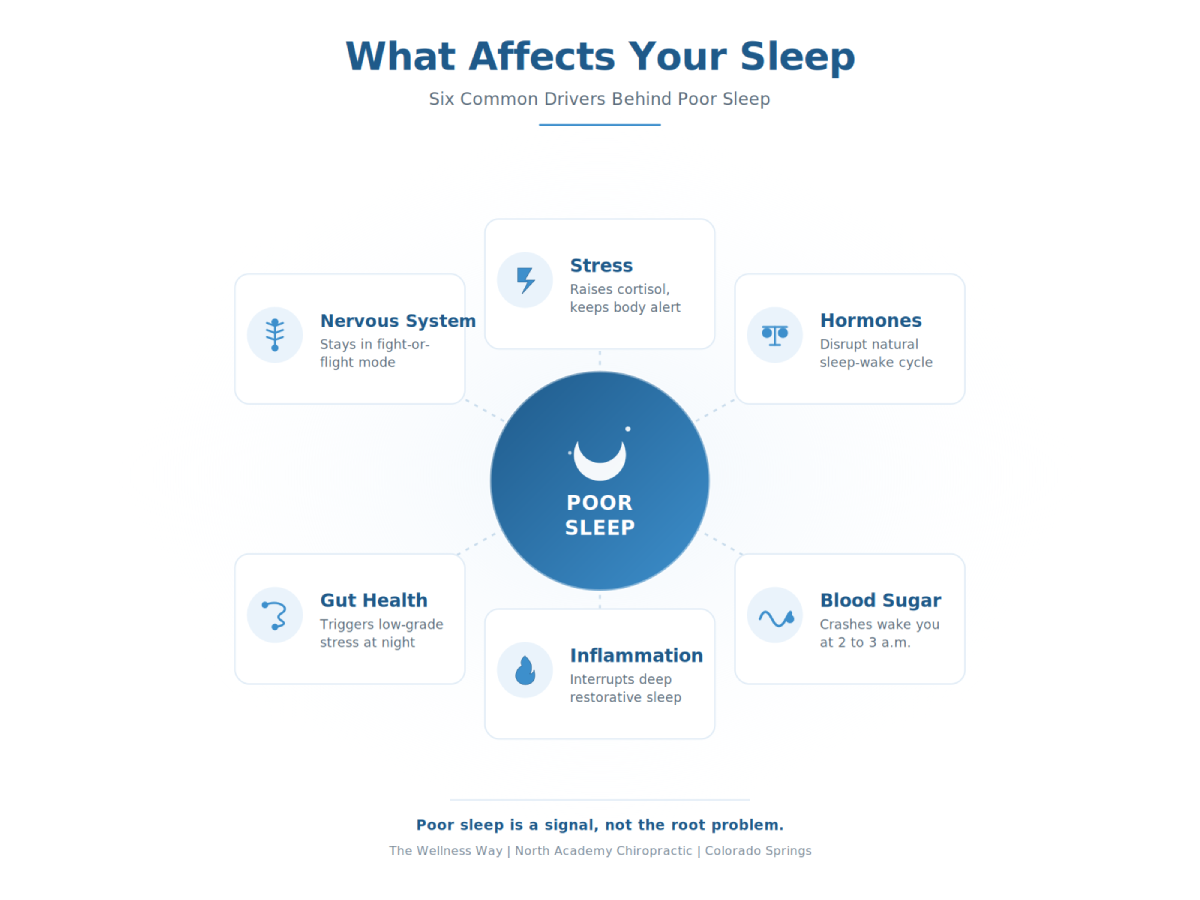
This is one of the most overlooked pieces. Your nervous system controls how every other system in the body adapts and communicates. When the nervous system is stuck in fight-or-flight mode, it drives up stress hormones, suppresses digestion, disrupts sleep, and worsens inflammation. None of that shows up on a standard blood test.
Chiropractic care supports nervous system function by reducing the physical stress the body is carrying. When the spine is moving well and the nervous system is less overloaded, the body can shift into repair mode more easily. For many patients, this is the piece that connects everything else. Better nervous system function allows hormones, digestion, inflammation, and sleep to all start recalibrating.
A Better Question to Ask
Instead of asking, “Are my labs normal?” a better question is:
What could be driving these symptoms that have not been fully evaluated yet?
That shift changes everything. It moves the conversation from looking for disease to looking for dysfunction. From chasing a diagnosis to understanding what your body is actually telling you.
What Comprehensive Testing Looks Like
A more complete approach looks beyond basic ranges and asks a different set of questions:
- Are these values optimal for how this person feels, not just inside the reference range?
- Are we looking at the full system, or just one marker in isolation?
- Are there underlying drivers like inflammation, gut dysfunction, or immune stress?
- Are food sensitivities contributing to the symptom pattern?
- Is the nervous system stuck in a stress response that is affecting everything else?
This is where deeper, more comprehensive testing can provide real clarity. It is also where a root-cause approach starts to make sense of symptoms that have not added up before.
The Goal Is Feeling Well, Not Just Normal Labs
You do not need to wait until something is bad enough to show up clearly on a standard test. Your symptoms already matter. When you understand what your body is communicating, you can start addressing root causes instead of chasing symptoms one by one.
If your labs are normal but you still feel sick, that does not mean there is no explanation. It means the explanation has not been found yet.
Get Root-Cause Answers in Colorado With The Wellness Way
If your labs are normal but you still feel sick, it may be time to take a more comprehensive look. At The Wellness Way in Colorado Springs, we evaluate the body as a whole, hormones, inflammation, gut health, nervous system function, and the lifestyle patterns that tie it all together, so you can finally connect the dots behind your symptoms.Schedule a consultation or attend one of our workshops to learn how we help patients move from frustration to clarity, and from symptom-chasing to real, lasting answers.